Last week Greg Ferro wrote about the use of merchant silicon in networking products. I'd like to share some thoughts on the topic.
Chip cost
 We know the story by now: by selling chips into products from multiple networking companies, commodity chips sell in large volume and benefit from larger discounts. This is a compelling factor in the low end of the switching market, where margins are thin and a primary selling point is price.
Yet low price of the switch silicon is not a decisive factor in the midrange and high end of the switching market, where products are more featureful and sell at higher prices. The price of those products is not based on the cost of materials, its based on what the market will bear. The market has traditionally borne a lot: Cisco's profit margins in these segments have been legendary for a decade.
In my experience, chip price was not a decisive factor in the wholesale move to merchant silicon.
Non Recurring Engineering (NRE cost)
 Say it costs $10 million to design a chipset for a high end switch, and the resulting set of silicon costs $500 in the expected volumes. If that high end switch sells 10,000 units in its first year then the NRE cost for developing it amounts to $1,000 per unit, double the cost of buying the chip itself. The longer the model remains in production the more its cost can be amortized... but the company has to pay the complete cost to develop the silicon before the first unit is sold.
In the midrange and high end switch markets, the strongest pitch made by merchant semiconductor suppliers wasn't the per-chip cost. A stronger pitch for those segments was elimination of NRE. The networking company didn't have to bear the cost of chip development up front. The company did pay the cost of development, but it would be factored into the unit price and pay-as-you-go rather than upfront.
Yet even NRE savings wasn't usually enough to convince a networking company to give up its own ASIC designs. Most realized that to do so was to give up a substantial portion of their ability to differentiate their products. Several vendors adopted a hybrid approach. They used merchant silicon to provide the fabric and handle simple cases of packet forwarding, and configured flow rules to steer interesting packets out to a separate device for additional handling. Costs were reduced by only having to design that specialized chip for a subset of the total traffic through the box, but they retained an ability to differentiate features.
In my experience, eliminating the burden of NRE was not a decisive factor in the move to merchant silicon.
Schedule
 The merchant silicon vendors of the world can dedicate more ASIC engineers to their projects. This isn't as big a win as it sounds: tripling the size of the design team does not result in a chip with 3x the features or in 1/3rd the time. As with software projects (see The Mythical Man Month), the increasing coordination overhead of a larger team results in steeply diminishing returns.
Instead, merchant silicon vendors have the luxury of working on multiple projects in parallel. They can have two teams leapfrogging each other, each working on a multiyear timeline and introducing their products in interleaving years. Alternately, they can target different chips at different market segments. They rely on their SDK to hide gratuitous differences which they happened to introduce, and only make their customers deal with the truly differentiating features of the different chips.
It is difficult to make a case to spend two years to develop custom silicon for a product when merchant silicon with sufficient features is expected to be available a year earlier. Merchant silicon suppliers share details of their roadmap very early, even before the feature set is finalized. This lets them incorporate feedback into the features for the final product, but they also do it to derail in-house silicon efforts.
Yet in my experience at least, though schedule is a decisive factor, this isn't the full story.
Misaligned Incentives
When leading a chip development effort, the biggest fear is not that the chip will have bugs. Many ASIC bugs can be worked around in software.
The biggest fear is not that the chip will be larger and more costly than planned. That is a negotiation issue with the silicon fab, or a business issue in positioning the product.
The biggest fear is that the chip will be late. Missing the market window is the worst kind of failure for an ASIC. The design team produces a chip which meets all requirements, but comes at a time when the market no longer cares. The tardy product will face significant pricing pressure on the day of introduction, more so the longer competitive products have been available.
The technical leadership of an internal ASIC project is therefore incented to plan a schedule which they are sure they can meet. They'll use realistic timelines for the different phases of the product, and include sufficient padding to handle unexpected problems. They will produce best case timelines as well, but those tend to be discounted by the project leadership as unrealistic.
The technical leadership inside merchant semiconductor companies face the same issues, and produce the same sort of schedule which they are confident they can meet. The difference is, that conservative schedule is not handed out to the decision makers at the customer networking vendors. A more optimistic schedule is maintained and presented to customers - not rosy best case, but certainly optimistic. Everybody knows that schedule will slip, even the customers themselves... but nonetheless it works. Customers work from the optimistic schedule because that is all they have. It increases the difference in schedule between in-house and merchant options by several quarters.
The Point of No Return
ASIC design requires some rather specialized skill sets. There is a great deal of similarity between chip design and software design, but not so much that one can switch freely back and forth. If there is not an active chip development effort underway, the ASIC team tends to run out of interesting things to work on.
When a company begins seriously contemplating building their high end products using merchant silicon, even if the management tries to keep it low key, it becomes pretty obvious internally. You have to pull in senior technical folks from the software, hardware, and ASIC teams to help with the evaluation. News spreads. Gossip spreads faster. If the ASIC team becomes convinced that there will be no further chip projects, they start to move on.
It can easily become a self-fulfilling prophecy: serious consideration of a move to merchant silicon leads to loss of the capability to develop custom ASICs.
Why it Matters
We talk a lot about Software Defined Networking. The term, consciously or not, tends to make people think the networking is all in software and the hardware is insignificant. That isn't actually true, as the SDN can only utilize actions which the hardware can actually do, but it illustrates how much less we value we put in hardware now.
In the context of SDN, reducing switch hardware diversity is actually a good thing. It results in a more uniform set of capabilities in networks, and a smaller set of cases for the SDN controller to have to handle. Networking used to be dominated by the hardware designs, but it has moved on now. I think that is a good thing.
 Lets consider a typical processing path for sending a packet in a Unix system in the early 1990s:
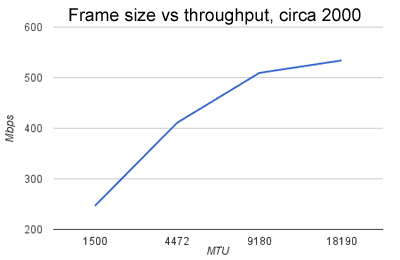 I have data on packet size versus throughput in this timeframe, collected in the last months of 2000. It was gathered for a presentation at
 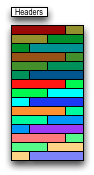 Large Segment Offload (LSO), referred to as TCP Segmentation Offload (TSO) in Linux circles, is a technique to copy a large chunk of data from the application process and hand it as-is to the NIC. The protocol stack generates a single set of Ethernet+TCP+IP header to use as a template, and the NIC handles the details of incrementing the sequence number and calculating fresh checksums for a new header prepended to each packet. Chunks of 32K and 64K are common, so the NIC transmits 21 or 42 TCP segments without further intervention from the protocol stack.
 QFabric consists of Nodes at the edges wired to large Interconnect switches in the core. The whole collection is monitored and managed by out of band Directors. Juniper emphasizes that the QFabric should be thought of as a single distributed switch, not as a network of individual switches. The entire QFabric is managed as one entity.
 The fundamental distinction between QFabric and conventional switches is in the forwarding decision. In a conventional switch topology each layer of switching looks at the L2/L3 headers to figure out what to do. The edge switch sends the packet to the distribution switch, which examines the headers again before sending the packet on towards the core (which examines the headers again). QFabric does not work this way.
  I don't know the answer, but I suspect it has to do with Link Aggregation (LAG). Server Node Groups allow a LAG to be configured using ports spanning the two Nodes. In a chassis switch, LAG is handled by the ingress chip. It looks up the destination address to find the destination port. Every chip knows the membership of all LAGs in the chassis. The ingress chip computes a hash of the packet to pick which LAG member port to send the packet to. This is how LAG member ports can be on different line cards, the ingress port sends it to the correct card.
 The downside of implementing LAG at ingress is that every chip has to know the membership of all LAGs in the system. Whenever a LAG member port goes down, all chips have to be updated to stop using it. With QFabric, where ingress chips are distributed across a network and the largest fabric could have thousands of server LAG connections, updating all of the Nodes whenever a link goes down could take a really long time. LAG failure is supposed to be quick, with minimal packet loss when a link fails. Therefore I wonder if Juniper has implemented LAG a bit differently, perhaps by handling member port selection in the Interconnect, in order to minimize the time to handle a member port failure.
 Until quite recently these systems had to be constructed using a standard routing protocol, because that is what the routers would support. BGP is a reasonable choice for this because its interoperability between modern implementations is excellent. The optimization system would peer with the routers, periodically recompute the desired behavior, and export those choices as the best route to destinations. To avoid having the Optimizer be a single point of failure able to bring down the entire network, the routers would retain peering connections with each other at a low weight as a fallback. The fallback routes would never be used so long as the Optimizer routes are present.
 Product support for software defined networking is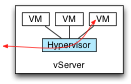






 An important topic for tunneling protocols is multipathing. When multiple paths are available to a destination, either LACP at L2 or ECMP at L3, the switches have to choose which link to use. It is important that packets on the same flow stay in order, as protocols like TCP use excessive reordering as an indication of congestion. Switches hash packet headers to select a link, so packets with the same headers will always choose the same link.
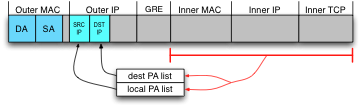 The NVGRE draft proposes that each NVGRE Endpoint have multiple Provider Addresses. The Endpoints can choose one of several source and destination IP addresses in the encapsulating IP header, to provide variance to spread load across LACP and ECMP links. The draft says that when the Endpoint has multiple PAs, each Customer Address will be provisioned to use one of them. In practice I suspect it would be better were the NVGRE Endpoint to hash the Inner headers to choose addresses, and distribute the load for each Customer Address across all links.
 The relatively limited variance in headers leads to an obvious next step: ensure the traffic will be balanced by predicting what the switch will do, and choose Provider IP addresses to optimize and ensure it is well balanced. In networking today we tend to solve problems by making the edges smarter.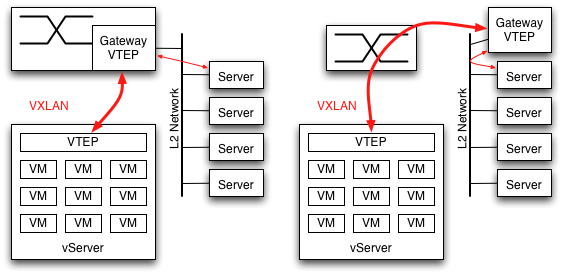
 I'm tempted to say there isn't a transition strategy. Thats a bit too harsh in that the Gateway function just described can serve as a proxy, but its not far from the mark. As described in
  What makes this transition strategy difficult to accept is that VMs have to be configured to be part of a VXLAN. They have to be assigned to a particular VNI, and that VNI has to be given an IP multicast address to use for flooding. Therefore something, somewhere knows the complete list of VMs which should be part of the VXLAN. In
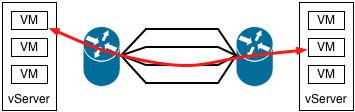 The UDP header serves an interesting purpose, it isn't there to perform the multiplexing role UDP normally serves. When switches have multiple paths available to a destination, whether an L2 trunk or L3 multipathing, the specific link is chosen by hashing packet headers. Most switch hardware is quite limited in how it computes the hash: the outermost L2/L3/L4 headers. Some chips can examine the inner headers of long-established tunneling protocols like GRE/MAC-in-MAC/IP-in-IP. For a new protocol like VXLAN, it would take years for silicon support for the inner headers to become common.
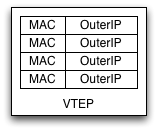 The VTEP examines the destination MAC address of frames it handles, looking up the IP address of the VTEP for that destination. This MAC:OuterIP mapping table is populated by learning, very much like an L2 switch discovers the port mappings for MAC addresses. When a VM wishes to communicate with another VM it generally first sends a broadcast ARP, which its VTEP will send to the multicast group for its VNI. All of the other VTEPs will learn the Inner MAC address of the sending VM and Outer IP address of its VTEP from this packet. The destination VM will respond to the ARP via a unicast message back to the sender, which allows the original VTEP to learn the destination mapping as well.
 Though it is appealing to let VTEPs track each other automatically using multicast and learning, I suspect beyond a certain scale of network that isn't going to work very well. Multicast frames are not reliably delivered, and because they fan out to all nodes they tend to become ever less reliable as the number of nodes increases. The
