I currently work in a relatively large development team. As is the case with every team of that size, we are organized as one enormous group where everybody works with everybody else, every day. I've graphed out our team interactions. I'm sure it looks a lot like your team, right?
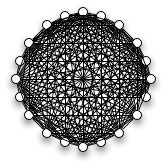
 Wait: does that sound weird, based on your experience? You're right, I made it all up. We're not organized as one enormous group, we're grouped into smaller teams like everybody else. Yet to a degree, the larger group has to be able to coordinate between every single person, every day. How is this accomplished?
Even in a relatively small group of people, a certain pattern emerges. Most individuals in the group interact with a small number of others, but a few are far more highly connected and routinely interact with dramatically more. These connectors result in enormous groups, loosely coupled. This is the phenomena which leads to the six degrees of separation theory, that on average any two people on the planet can be connected by six friends of friends. This pattern is also the basis of the six degrees of Kevin Bacon, who is one of those "highly connected" nodes in the graph of film actors.
The Small World Pattern
This phenomena is called the Small World pattern. I first read about it in Here Comes Everybody.

Here Comes Everybody, chapter 9.
... the chance that you know [a highly connected person] is high. And the "knowing someone in common" link - the thing that makes you exclaim "Small World!" with your seat mate - is specifically about that kind of connection.
The Small World Pattern seems obvious, in hindsight. Of course some people are simply more social and outgoing that others. They make an effort to meet people. They form connections. They are far more connected to other people than most.
The rest of this musing will concern the Small World Pattern in engineering organizations.
The Small World Scoffs at Your Orgchart
Connections can be forced, organizationally: a regular meeting between tech leads from related projects, for example. Connections can also happen by happenstance, as when members of different teams work at adjacent desks. However, the strongest connections happen because some percentage of the engineering population wants to be connected. They are outgoing, and enjoy talking to people outside their immediate coworkers. These connections are far more persistent, and likely to survive past the end of any particular project or recurring meeting.
No Group is an Island, but Some are Peninsulas
Something which can happen in a large company: you work on an infrastructure project which should be applicable in a number of different areas, yet never seems to get the attention you think it deserves. Other groups which could leverage your work instead do their own thing, and later only grudgingly evaluate your system before pronouncing it unfit. Is it because you've misunderstood their requirements? Is it because they think your implementation is poor?
More likely, its because you lack connections from your group to others. It takes just one person in the right place at the right time to say "we should go talk to John on Project Foo." When these suggestions are made organically and at the right time, they are far more likely to be acted upon. When such a suggestion comes as an edict way after the decision point, such as via some recurring meeting, it is far less likely to be received favorably.
To the Connector Go the Spoils
Being highly connected within an engineering organization reaps many rewards. People associate them with the good outcomes of serendipitous introductions.
Being highly connected within an engineering organization also suffers some downsides. I wish I understood the psychological reason why, but nonetheless it happens: Technical competence as an individual contributor will be questioned more often if you spend significant time interacting with other groups. Its weird.
Closing Thoughts
Engineers are human, though in your daily work it might not always seem so. Understanding human behavior is as important in our field as in any other. I highly recommend Shirky's Here Comes Everybody, and his subsequent Cognitive Surplus. Both are excellent.

 Fiber optic strands have a central core of material with a high refractive index surrounded by a jacket of material with a slightly lower index. The ratio of the two is set to cause total internal reflection, where the light is confined to the central region and won't diffuse out into the cladding.

 Leakage current became a significant contributor to power consumption in 2003 with the move from 0.18 to 0.13 micron feature sizes, and has become more significant in each subsequent generation. The industry is now moving into 0.032 micron technologies.
 Virtual Machine architectures are a fascinating topic, and one that I plan to
  The
The  Dalvik is the virtual machine for Android application code. The Dalvik instruction set implements an interesting compromise: it is register based, but there are a finite number of them as opposed to the theoretically infinite registers of LLVM or Parrot. Dalvik supports 65,536 registers, a vast number compared to hardware CPUs and presumably sufficient to implement SSA (if desired) in reasonably large functions.

 Every handful of years we ratchet up the Ethernet link speed: from 10 Mbps to 100 Mbps in the early 1990s, to 1 Gbps in the mid 1990s, to 10 Gbps in the early part of this century. 40 Gbps is the next target. At the 1 Gbps and 10 Gbps transitions naysayers maintained that copper cables would never be able to meet the required signaling rates and that optical would prevail. The same doubt is now being voiced about 40 Gbps.

 A modern switch fabric chip is designed for both L2 ethernet switching and L3 IP routing. The additional logic for IP routing adds relatively little area in modern silicon technologies, while not having a routing capability would put them at a competitive disadvantage. Essentially all ethernet fabric chips, even those inside relatively cheap L2 switches, have the design features to route IPv4 traffic to at least a basic degree.
 The fabric chip they use wasn't specifically designed for such low cost switches, there is not enough profit to justify the effort. In addition to simple L2 switches those chips can be used to build NAT appliances, as the ethernet fan-out for small wireless access points, in DSL and cable routers, for low end WAN routers, etc. When only basic L2 switching is desired these fabrics can function completely standalone without a management CPU, reducing BOM cost to the bare minimum. Addition of a CPU allows the basic L3 functions to be used in the more featureful (but still low end) products.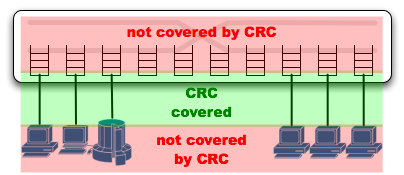

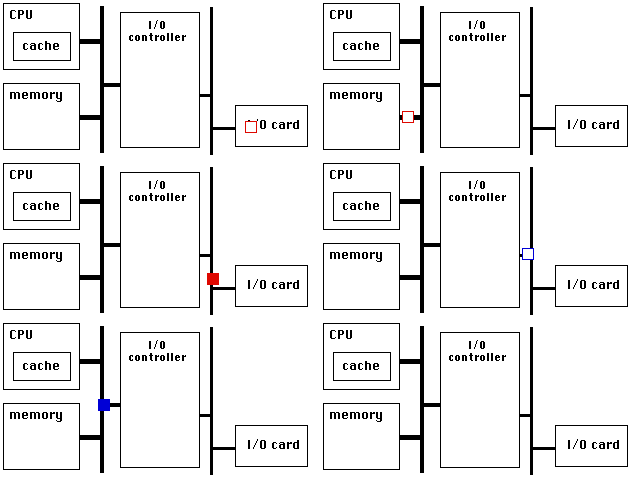
 PCIe has a very high link bandwidth, making it easy to forget that its position in the system imposes several levels of bridging with correspondingly long latency to get to memory. The PCIe transaction first traverses the Northbridge and any internal switching or bus bridging it contains, on its way to the processor interconnect. The interconnect is HyperTransport for AMD CPUs, and QuickPath for Intel. Depending on the platform, the transaction might have to travel through multiple CPUs before it reaches its destination memory controller, where it can finally access its data. A PCIe Read transaction must then wend its way back through the same path to return the requested data.


 For at least 15 years that I know of, chip designs have improved their yield using redundancy. The earliest such efforts were done in on-chip memory: if your chip is supposed to include N banks of SRAM, put N+1 banks on the die connected with wires in the top most layer which can be cut using a laser. The SRAM occupies a large percentage of the total chip area, statistically it is likely that defects will be within the SRAM. You can then cut out the defective bank, and turn a defective chip into one that can be used. More recent silicon processes use fuses blown by the test fixture instead of lasers.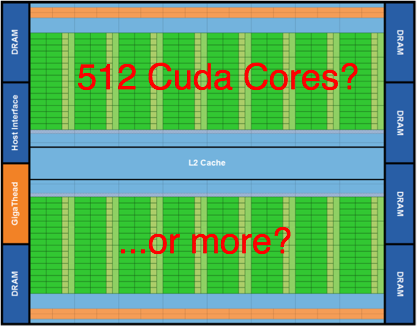
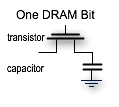 Soft errors are usually discussed in the context of DRAM, where the problem was initially noticed. DRAM consists of a capacitor to store the bit, with a transistor to keep the capacitor charge stable. A capacitor is an energy storage circuit: it stores voltage. A particle strike on the capacitor will impart a large amount of energy, which can spontaneously change it to a 1 or, more rarely, overload its capacity such that the energy quickly escapes into the substrate and leaves the bit as a 0.
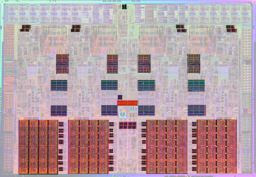 Modern CPUs include a great deal of SRAM on the die, comprising the caches, TLBs, reorder buffers, and numerous other uses. The image shown here is Intel's quad core