Showing posts with label websites. Show all posts

Wednesday, March 16, 2011

RIP www.sun.com

www.sun.com will be retired on June 1, 2011. Some of the content will move to Oracle sites. The rest will be discarded.

My recollection is that the Sun web site started in about 1994. When the Wayback Machine started in 1996, www.sun.com had been taken over by Sun corporate. Before that the earliest pages were put together by engineers. It was all very basic stuff, just text and images. Even the <TABLE> tag did not exist at that point.

Tombstone for www.sun.com

Wednesday, December 29, 2010

OneTrueFan Observation

OneTrueFan is a service to track web history, allowing web users to see what sites they spend the most time visiting. It also allows site operators to see their most active users, though only amongst those who have signed up for the service. You can read more about OnerueFan here.

Users accumulate points for a site by visiting, sharing links, and other activities. OneTrueFan rate limits point increases amongst players to one point every few seconds. I have no way to tell if this was intended to discourage gaming of the system, or is a coalescing mechanism for scalability which batches site hits every few seconds. Nonetheless for any site with a large collection of pages, at present it is relatively easy to take the OneTrueFan title.

Screenshot of louisgray.com showing me as the One True Fan

My list of shared itemsUsers who have installed the OTF browser extension see the web bar on every site they visit. Site owners can also install the web bar on their pages, making it visible to all visitors whether they use the browser extension or not. Hovering over the pictures in the web bar shows a list of recently shared links. My list of shared links is relatively tame. Its not difficult to imagine links to WoW Gold sales, or porn sites, or any of the other innumerable schemes which spam is used to peddle. The potential for mischief is there.

It is possible that OneTrueFan already has effective spam controls, focussed on the shared links rather than on obtaining the top spot in the fan list. I did not create a profile with spam links to check, nor do I intend to. In any case I expect they realize the importance of effective spam controls for a service which inserts content into other websites, and need to continue to focus on it.


Update: In the comments Eric Marcoullier (co-founder and co-CEO of OneTrueFan) described the current spam prevention tools in the service, and discussed some plans for the future.

Wednesday, September 29, 2010

Twitter URL Search No Worky?

Twitter logoSomething is wonky with twitter's search function. In May 2010 twitter search started returning results for keywords in the original, unshortened links passing through the service. Were http://example.com/booga to be shortened and tweeted, searches for "example" and "booga" would turn up the tweet.

At some point in late September 2010 this seems to have changed. Now the original URL is generally not matched, with the possible exceptions of Top Tweets, Promoted Tweets, and Twitter's own t.co shortener. The change seems to have ramped in slowly, as even three days ago I was seeing some shortened URLs turn up in search results, while others did not. There were also a couple examples of the host portion like example.com not being indexed, but the rest of the URL triggering search results. I thought it was a glitch, but as of 9/28 it seems consistent: URLs behind third party shorteners are not being indexed.

Its possible this is just a glitch due to traffic growth. It could be a normal adjustment to the Twitter service, attempting to tweak search results for better relevance. It could be a rather bold incentive to use Twitter's URL shortener. However I cannot help but notice that it also makes room for features relating to brand management. Searching for something specific might use the regular search service, while monitoring for all links pointing to a site could be a service from a different, premium system.

Update: Apparently its just me. Tweets sent from @dgentry containing shortened links do not appear in search results for keywords in the original URL, starting late September. For example, the following tweets did not appear in search results for codingrelic or geekhold: 1 2 3 4 5 6 7 8. I also noticed thiat this tweet did not appear in a search for "ifixit." I suspect that this affects any tweet I've sent since mid-September, but I didn't start checking all of them until I realized there was a problem.

Friday, May 14, 2010

Uncanny Friending

There is an urban legend that Eskimos have many different words for snow. The truth is the Aleut languages have about as many words for snow as does English, but allow descriptive suffixes to be attached to any word to form countless variations.

Consider the English words we use to describe human relationships, and the distinctions they convey in meaning:

sisterstepsisterhalf sister
significant otherfiancéespouse
friendjust friendsfriend with benefits
peercoworkercolleague
motherstepmothergodmother

We use adjectives to add huge amounts of information in a single word. "fiancée" conveys one meaning, that of a beloved person. "current fiancée" conveys an entirely different meaning, a disposable relationship given a label for convenience.

Now consider the words we use to describe relationships in social networks:

friendfriendfriend
friendfriendfriend
friendfriendfriend
friendfriendfriend
friendfriendfriend

Why do we find this unsatisfying? I believe it is a corollary to the Uncanny Valley effect in robotics and computer games: "friend" is close enough to the real description of the human relationship that we find it unsettling. If the term were more inhuman, less shaded with meaning, it would not be so maddening.

The term "like" has a similar problem: who wants to like something unpleasant or unsavory? Clicking "like" is meant is to express interest, but the terminology is close enough to the real intention to be maddeningly imprecise.

I also suspect this vaguely unsettling feeling will resolve itself in a few more years online: the words friend and like will simply lose all meaning. We'll know this has been achieved when people stop using air quotes to distinguish online friending versus real life friends.


This genesis of this musing came via an insightful tweet by Marshall Kirkpatrick:


told my wife that google "results from your social circle" showed me because we are friends. she insists we are more than that. true :) less than a minute ago via TweetDeck Marshall Kirkpatrick
marshallk

Wednesday, May 5, 2010

Privacy vs Voyeurism

Much has been written about privacy online. When Pandora reveals our friend's music tastes it makes us slightly uncomfortable, even if we enjoy the new music suggestions which result. When our friends can unknowingly reveal information about us, we find it disturbing. Facebook privacy currently dominates the discussion, but the trend of all online activity has been more sharing and less privacy.

I use foursquare, which allows friends on that service to see your location when you checkin. Earlier this week a friend checked in to the Lucile Packard Children's Hospital.

Hospital Heart/Lung monitor screen

A checkin notification is devoid of context; there was no indication if it was routine or emergency. Certainly if one had just rushed a child to the hospital one wouldn't bother checking in... but what about hours later? What about an extended stay, after initial panic subsides? Where detail is lacking, the mind fills in possibilities. After thinking about it for a while, worry overcame reservation and I sent email asking if there was anything I could do to help.

As it happens, the visit was completely routine.

It felt weird, asking if everything was ok. I was acting on the basis of information which even just a couple years ago would not have been available to me. Back then I would only have known if he'd informed me directly, and in that context asking if I could help wouldn't have seemed even slightly awkward.

Even if it hadn't been a routine visit, even if there had been help I could provide, reaching out on the basis of a foursquare checkin would have still felt weird. Why is that? I think it is a form of guilt, as using social media in this way feels a bit like voyeurism. In this case it was information the person had chosen to share by explicitly checking in on foursquare, but down in the subconscious it is still equated to clandestine spying.

As online privacy recedes, I think we're all going to be experiencing this feeling more often.


Thoughts on Sharing

Society does not inherently guarantee our privacy. It never did. The privacy most of us enjoy is actually anonymity. Celebrities struggle greatly to keep any portion of their lives out of public view; when you discard anonymity, privacy tends to go with it. As communications technology improves, the bar to achieve a degree of celebrity is lowered. I suspect the further back in history you go the difference will be the geographical radius of ones renown, not its impact.

We're rushing into a world where a huge percentage of the population will experience the advantages and disadvantages of losing anonymity in their daily lives.

  • The eCommerce site will know your approximate net worth.
  • The customer service response will be finely tuned to the likelihood your displeasure could damage their business.
  • Product companies will assemble marketing lists of people who are statistically more likely to buy their product. Not by placing ads in venues they are likely to frequent, but by targeting them directly.
  • When I look for a dance class for my daughter, I'll know if her friends are already enrolled somewhere without having to ask them.
  • Insurance as we know it today will fade away, uncompetitive. It will not use actuary tables, it will be essentially an auction based on a tailored risk profile.

We might recoil from this, but I suspect it is not something which can be stopped. The technology has reached the point where these things are feasible, and there is a huge economic incentive to do so. A concerted effort to stop it results in the technology being less visible, not absent.

Update: Louis Gray, the friend whose hospital checkin triggered this musing, has posted some thoughts on location-based services and what information we make available to others.

Thursday, March 18, 2010

My Name Is ...

Please search for your name in a search engine, whichever one you prefer. Put quotes around your name or not, use a nickname or not, whatever you like. Now: are you satisfied with what you see in the results? If someone else searches for your name, what are they likely to think?

You don't get a second chance to make a first impression, even when that impression comes from a web search.

This blog was born two years ago because I wasn't happy with the search results for my name. At that time the top Google results were IEEE presentations from years ago on Resilient Packet Ring and Ethernet OAM. So lets check how its going:

Google Search results getsatisfaction.com #1, linkedin #2, listorious #3

Within the top four is ok. The results on Bing are significantly different, this site appears on page three. Bing appears to not automatically treat the two words as a name, so it finds pages where both words appear separately. Enclosing the two words in quotes to enforce proximity refines the search considerably, to the first page.


Claim Your Name Online

In 2010, I think everyone should have a URL to use whenever a personal link is needed. It doesn't have to be a blog: it could be your Facebook or Twitter page, a flickr group you contribute to, LinkedIn, etc, just something to link to whenever the situation arises. This question will come up more and more often as the Internet becomes ever more embedded into our society.

Its worthwhile spending a bit of time on the selection. Once you start building up links to this URL it will be difficult to change them. If you point to a domain you don't own, like twitter/facebook/flickr/etc, you have no control over whether they remain reachable. Those services seem like they will last forever, but so did GeoCities and Compuserve in their day. Personally I recommend using a domain name which you own. You don't have to run your own server, for example Blogger, Posterous and Tumblr are all free hosted platforms which allow you to use your own domain name.

Once you've picked a URL which conveys the positive first impression you want, start using it. twitter, LinkedIn, stackoverflow, and many other services you might already use let you include a link in your profile. Comments on blogs (like this one) let you use a URL for your name. You can also sign up for a Google profile, which can link to all of the services you want and will appear on name-query search pages.


Strategy: Search Engine Optimization

Once you decide you want to control the search results for your name, it is helpful to understand the basics of Search Engine Optimization (SEO). There is an astonishing amount of information online about SEO, much of it seemingly written by people who consider it a kind of magic for which they exchange incantations and arcane formulae. Most of it makes no sense to me, but a couple things did sink in:

  1. The number of links pointing to a page matters. Writing an astonishingly useful resource which lots of people will link to is a great strategy. I'm still working on that strategy. It turns out to be difficult. Who knew?
  2. When it comes to keywords, DNS > URL > title > body. That is, a keyword occurring in the site's DNS name is weighted more than a keyword in the URL for a page. The URL is weighted more than the same keyword in the page <title>, which is itself weighted more than the body of the page.

 
Tactics: Kneecap the Competition

We're firmly in the web2.0 era, with numerous social web sites vying for our attention. They are also vying for our identity, encouraging people to sign up using their real name. As these are very popular services, they will have lots of inbound links and quickly achieve a higher search ranking for your name than something you create on your own. This is especially true if you use your full name: your profile will contain your name in the URL, which is weighted more heavily. You'll note that in the search results above, two of the top three hits use my name in the URL while the third has it in the <title>.

Stackoverflow change name from denton-gentry to dgentryThere used to be more, with StackOverflow and friendfeed rounding out the top five. Fortunately the username could be changed on both services, relegating them lower in the list. So if you aren't happy with the top results for your name, its often possible to do something about it. You can change your login to an abbreviation or pseudonym, or delete accounts which you no longer use.


Think Long Term

Nudging positive material into the search results for your name is one thing. Its equally important, perhaps even more important, to keep material which reflects poorly on you out of the results. Jeremy Toeman published a good article about things one should never do online. I think the common sense rule is not to publish things you would regret later, not even if you think you understand privacy settings or conceal the URL.

Thats all. Please let me know your experiences with the search results for your name.

Tuesday, November 24, 2009

Mayor For Life on Foursquare

foursquare.comfoursquare is one of the early entrants in a coming wave of location-based web services. Foursquare catalogs a huge list of venues in 100 cities around the globe: restaurants, movie theaters, museums, bars, etc. You checkin with the service as you visit these places, and the system tells you tips that other foursquare users have suggested about that location. It also (optionally) broadcasts your checkin to your friends, so you can arrange meetups or just learn about new spots by watching their activities. Currently you set up your friend lists on the foursquare web site, though it does provide a way to check whether any of your twitter, facebook, or GMail contacts are using foursquare.


foursquare badgesAn interesting aspect of foursquare is the gaming angle. Badges are awarded for a huge range of activities, for example four checkins in one day earns the "crunked" badge. It looks like a drunk happy face, though in my case no alcohol was involved: Children's Discovery Museum, a local park, Fry's Electronics, and a restaurant. As with stackoverflow, badges provide a way for the developers to reward proper use of the site which doesn't cost them any money.

Finally, there is Mayorship. The person who has checked in to a venue the most in the last 60 days is declared to be the Mayor. You can steal the Mayorship away from its current holder by visiting more often, which gives the site a competitive feeling. Apparently the competition for Mayorship of hot nightspots is intense, complete with accusations of cheating. An old saying about academia springs to mind: "On foursquare, tempers run high because the stakes are so small." Nonetheless, the Children's Discovery Museum Mayorship is mine. Don't even think about trying to take it.

foursquare mayor of the Childrens Discovery Museum

A small number of business owners offer rewards to their foursquare mayor, typically on the order of a free drink. This hints at a route foursquare can take to monetize the site, by allowing businesses to reach out to patrons. The challenge will be to do this in a way that isn't creepy: a leaderboard to see how close I am to becoming Mayor would be fine, actively bugging me to visit more often would not be.


About SMS...

SonyEricsson T616The best experience using the service is with a GPS-enabled smartphone. There are free apps available for iPhone and Android, and there is a mobile-optimized website for phones with a reasonable browser. Finally, there is SMS. As I still use an ancient DumbPhone, I use SMS. One of these years, I'll buy a new phone.

foursquare is clearly aimed at people with better phones. You have to type the venue name exactly, there is no fuzzy matching. If your checkin is not recognized, there is no way to correct it after the fact on the foursquare website. This can be very frustrating. Fred Wilson wrote about the importance of including SMS support in mobile apps, both to allow someone to try the service without having to install an app and to have an answer for the entire market. Certainly in my case, I wouldn't otherwise be able to use it.

Thursday, April 9, 2009

More Google App Engine - Feedflares

Today's article is a discussion about some of the infrastructure for running this site. So far as I can tell from the logs and analytics, nearly everyone reading this blog does so via RSS. The RSS feed for this site is provided by FeedBurner, now part of Google. FeedBurner supports FeedFlares, small widgets appended after the content which can supply additional information or link to other services. I currently use several FeedFlares in the RSS feed, for del.icio.us and friendfeed. The friendfeed flare is new, and is the topic of this writeup.
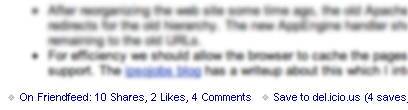

FeedFlare example


friendfeed.comfriendfeed is a social media aggregation service, collecting updates from services like Digg, Flickr, and various blog platforms into a single stream of updates. Many good articles about friendfeed can be found on louisgray.com.

The RSS feed for this blog is imported into friendfeed where people can see it, mark it as something they liked, or leave comments. At the time I started working on this project there was not a FeedFlare for friendfeed. There is now, but I decided to finish my version anyway and post it here. As Google App Engine is my favorite new toy, the FeedFlare is a GAE application.


We'll go straight to the code which gathers information from friendfeed to create the FeedFlare. I'm going to skip the boilerplate code for an application on the Google App Engine. It can be found on an earlier article about the App Engine, if needed. The complete source for this feedflare is also available for download.

class FriendfeedFlare(webapp.RequestHandler):
  def get(self):
    self.response.headers['Content-Type'] = "text/plain"

    scheme, host, path, param, query, frag = urlparse.urlparse(self.request.url)
    args = cgi.parse_qs(query)

    url      = self.parseArg(args, "url")
    nickname = self.parseArg(args, "nickname")
    api_key  = self.parseArg(args, "api_key")

    if (url == None):
        self.response.out.write("<FeedFlare><Text>No URL specified!</Text></FeedFlare>\n")
        return

    subscribed = 1 if (nickname != None and api_key != None) else 0

Three arguments are accepted, using the standard CGI convention of http://host/path?arg1=value&arg2=value

  • url - the url of the RSS item this FeedFlare should reference. This argument is required.
  • nickname - the friendfeed account to authenticate as. If provided, the search will be restricted to friends of this nickname. If not provided, we search all entries on friendfeed.com.
  • api_key - the API Key to authenticate us. If nickname is provided the api_key must also be provided.

Note: At the time of this writing (4/9/2009) the nickname functionality to restrict results to subscribers is not working. It was working a couple days ago, but seemed to break just as I posted this article. I'll update the post if I get it working again, for now the feedflare is useable when searching all entries on friendfeed.com.

urlparse.urlparse() is employed to break the URL into its main components, and then cgi.parse_qs() pulls out the individual parameters. parse_qs() returns each argument as a list, because it allows multiple instances of an argument. In this case only one makes sense, so we get back a list with one member. self.parseArg() is a small helper routine to return None if the argument is not present, or the first element in the list returned from cgi.parse_qs().

    try:
        ffsession = friendfeed.FriendFeed(nickname, api_key);
        entries   = ffsession.fetch_url_feed(url, subscribed);
    except IOError:
        self.error(503);
        return

Friendfeed supplies Python wrapper functions for their API. The wrapper functions are used here to connect to friendfeed.com, using the authorization credentials (if present). If friendfeed is not responding, a 503 response is sent to feedburner.com. This Service Unavailable result tells feedburner to continue to use its cached information and to try again later.

fetch_url_feed() is a function added to the friendfeed API, to support their /api/feed/url API. It fetches all entries which reference the given url.

    totalshares   = 0
    totalcomments = 0
    likers        = set()
    linkurl       = "http://friendfeed.com/"
    linkcomments  = -1
    
    for entry in entries["entries"]:
        totalshares   += 1
        numcomments    = len(entry["comments"])
        totalcomments += numcomments
        if (numcomments > linkcomments):
            linkurl = "http://friendfeed.com/e/" + entry["id"]
            linkcomments = numcomments
        for like in entry["likes"]:
            liker = like["user"]
            likers.add(liker["name"])

    totallikes = len(likers)

The friendfeed API returns entries in JSON format, which is parsed by their API and returned as nested Python lists. To count the number of likes and comments, one needs to iterate over each entry.

likers is a Python set, a datatype I learned about while working on this project. A set is a group of objects which will contain no duplicates. If you add an item to the set which is already present the set will contain only one instance of the item, not two. This is used to avoid overcounting likes: if the URL we are looking for was shared multiple times in friendfeed and the same user marked every one of them as liked, we only want to count that as one like not many.

The linkurl is a compromise. I'd really like to direct the link to a page containing all of the results for this URL. Unfortunately only the friendfeed JSON API includes URL search functionality, the web search page does not. So far as I can tell there is no way to link back to friendfeed for more than one entry ID. So here we link to the entry with the most comments.

    self.response.out.write("<FeedFlare>\n")
    if (totalshares == 0):
        self.response.out.write("  <Text>On Friendfeed: 0 shares</Text>\n")
    else:
        self.response.out.write("  <Text>On Friendfeed: " +                      \
                                self.fmtTotal(totalshares,   "Share")   + ", " + \
                                self.fmtTotal(totallikes,    "Like")    + ", " + \
                                self.fmtTotal(totalcomments, "Comment") +        \
                                "</Text>\n");
    self.response.out.write("  <Link href=\"" + linkurl + "\"/>\n");
    self.response.out.write("</FeedFlare>")
    return

Generate the XML output. self.fmtTotal() is another little helper routine to pluralize the output correctly, "1 Comment" versus "2 Comments" The result of all this processing is a simple bit of XML:

<FeedFlare>
  <Text>On Friendfeed: 5 Shares, 1 Like, 2 Comments</Text>
  <Link href="http://friendfeed.com/e/1b0141a1-f6fa-1be2-e775-e5d36959e04c"/>
</FeedFlare>

This is all feedburner needs to create the FeedFlare. All formatting, including the font size and the blue text coloring, is hard-coded by feedburner. The FeedFlare does not get to supply any formatting, just some text and an optional link.

  def fmtTotal(self, count, descr):
    suffix = "" if (count == 1) else "s"
    return str(count) + " " + descr + suffix

  def parseArg(self, args, argname):
    try:
        ret = args[argname][0]
    except:
        ret = None
    return ret
The aforementioned helper routines.


Thats it, or rather thats the interesting part. The complete source can be downloaded.

The next question is, what is missing? What does it not do, that perhaps it should?

  • There is no caching of the result. Every request for the FeedFlare results in another API request to friendfeed.com. I believe this is acceptable because FeedBurner limits the rate of FeedFlare requests to about one per two hours.
  • The link in the generated FeedFlare points to the friendfeed entry with the most comments. This is a compromise. I'd rather to link to a search results page with all of the entries regarding the given URL, but can not find a good way to do it. I'd have to make the FeedFlare dynamically construct a page populated with all of the links, showing all of the likes and comments... and that is too much work for this little project. I hope that someday, friendfeed.com will provide a way to supply multiple entry IDs to appear on a single page.

 
Using the FeedFlare

If you are interested in using this FeedFlare on your own blog, please feel free. You have a few options:

  1. To use it without a specific nickname (so the results will include Everyone on friendfeed whether they follow you or not) you can use this link as the Flare Unit URL in the Feedburner -> Optimize -> FeedFlares page for your feed.
  2. To configure it to only include people who subscribe to you on friendfeed, download http://feedflare.geekhold.com/feedflareunit/friendfeeduser.xml">friendfeeduser.xml. Replace MY_NICKNAME with your friendfeed account name, and MY_API_KEY with your Remote API Key, and put the modified file somewhere on your own site to be used to configure FeedBurner.
    The functionality to restrict the results to your subscribers is not working right now. Please stay tuned. I'll post an update on friendfeed.com if I get it working again.
  3. If you don't like something about the way this code works, you're free to modify it. You can download the source code, set up your own Google App Engine application, and modify it as desired.

Thursday, September 11, 2008

Random Musings on stackoverflow.com

stackoverflow.com

Stackoverflow.com is a site by programmers and for programmers, whose purpose is answering questions on topics relating to software development. At the time of this writing it has completed a closed beta test and is in a more extensive test phase, ramping up to open on September 15, 2008. Access to the beta site is open to anyone who wants it during the test period, see blog.stackoverflow.com for details.

Stackoverflow is the brainchild of Jeff Atwood and Joel Spolsky, long-time bloggers on software development topics. It is described by its creators as the intersection of a Wiki, blog, forum, and digg/reddit voting site. Users post questions and answers about programming topics, and the questions and answers are voted on by the community. The highest voted answers rise to the top.


Incentives, aka crackoverflow.com upvoting

The site has a series of incentives to keep people coming back. The biggest incentive is the reputation score, which goes up and down depending on how other users rate your questions and answers. Reputation encourages asking questions and providing answers, in order to improve ones score.

reputation Reputation is in many ways similar to the Karma awarded by reddit.com and Hacker News. Capabilities on the site are unlocked by having a high enough reputation. For example voting on posts requires a score of 15 or more, where new users start with a score of 1.

The other, more unique rewards system on stackoverflow are the badges. Badges are directly modeled after the achievements awarded in Xbox games, which encourage gameplay by granting an award when a level is completed or other objectives achieved. The achievements show up in a gamers profile on Xbox Live, where they are used to talk smack about opponents.

badges The stackoverflow badges encourage exploration of the features of the site. The first few badges area easy to obtain: fill out your profile to obtain the Autobiographer badge, vote up to get the Supporter badge, and gain the Teacher badge by asking a question which is voted up. Later badges get harder, requiring larger numbers of users to vote on your submissions.
Are these mechanisms effective? I think the reputation score is, certainly. As in a video game, there is a certain thrill to seeing ones score go up. The badges seem, well, hokey to me. I'll grant that I'm probably not the target demographic anyway, badges might have more resonance with those who play games regularly.


Content question votes

The questions during the stackoverflow beta have ranged widely, but by far the most common questions are about Microsoft topics like .Net and SQL Server. This is likely a reflection of the audience of Jeff and Joel's respective blogs being heavily invested in these technologies.

I've been pleasantly surprised by a number of the questions posed on the site. Where the programming sub-reddit is now completely dominated by Ruby, Python, and Haskell, stackoverflow is covering a much wider mix of technologies. There have even been a few embedded system and assembly language questions.


Technical solutions to social problems

The history of web communities dedicated to software developers has not been pretty. The comment section of the programming sub-reddit is now so filled with vitriol and casual slander as to be unpleasant to read, let alone participate in. Hacker News attempts to prevent this slide into toxicity by a combination of social pressure and technical measures like not allowing downvotes until a certain karma has been achieved.

Stackoverflow is relying heavily on technical solutions to social problems. For example:

  1. Downvotes are only allowed by those at higher reputations, and reduce the target reputation by two where an upvote adds ten. Additionally downvoting costs the voter one point of reputation, to discourage frequent use.
  2. To discourage trivial edits to bump a question to the top of the list, more than five edits to a post make it "community owned" and no longer grant reputation to its poster.
  3. Users with sufficiently high reputation can edit another users posts or comments, for example to remove mean-spirited remarks. It is hoped they will use these powers for Good and not Evil.
  4. Users can mark a question or answer as offensive. This does not merely signal a moderator; if enough users click offensive the question will be automatically removed.

 
Speed bumps coming

I really like the premise behind stackoverflow, of a social media site designed specifically for programmers. I think there is definitely a need which reddit, DZone, and other developer-focussed sites do not fill.

Editing another users post

However I think this initial iteration of stackoverflow has a psychological problem: it tries to simultaneously be a voting site like reddit and digg, and a community site like Wikipedia. What you end up with is postings associated with a particular users name, and which provide benefits in the form of reputation, but which can be edited by other users. The site attempts to ameliorate this by making a post "community owned" after five edits, so it no longer belongs to the posting user. This step function solution brings the opposite problem: the poster feels cheated out of the reputation from what has become a popular topic.

This mismatch between the digg and wikipedia models is not working smoothly yet, in my opinion. The digg model thrives on ownership, the wikipedia model on anonymity.

Some other thoughts about future issues:

  • On other sites even replying to someone else's comment can elicit a defensive reaction. I suspect that editing another user's question or answer on stackoverflow will lead to a series of edit-revert-edit-revert struggles.
  • There is an enormous incentive to answer quickly: the early answers accrue upvotes and gain significant inertia to accrue more upvotes. A number of users answer immediately by quoting Wikipedia or the first Google result, and gain significant reputation by doing so. stackoverflow will have difficulty succeeding if the highest rated answers are mostly Wikipedia rehashes.
  • The site is far more active during US business hours, and relatively idle during nights and weekends. When combined with the strong incentive to answer immediately, the site can become a productivity drain. We may see companies block stackoverflow in the same way that Facebook is often blocked.

 
Conclusion

I really like stackoverflow, and I want it to succeed. I think its business model is sound: focus on a well-defined niche, provide real value, and carefully select advertising to target that specific audience.

UPDATE: This article was picked up on reddit, with amusing commentary. Also Sara Chipps and Dan Dyer have written about their initial impressions of stackoverflow.