Showing posts with label astrostuff. Show all posts

Thursday, July 1, 2010

Voyager 2 Soft Error

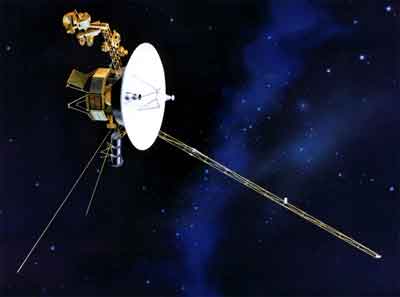
Voyager 2Voyager 2 is currently traversing the heliosphere, the shockwave where the solar wind and particles of the interstellar medium meet. Decades after launch the Voyager probes are still transmitting data back to Earth, at 160 bits per second. Starting April 22, 2010, the checksums in the Voyager 2 datastream indicated problems in every frame. Something bad had happened to the spacecraft.

After several weeks of testing, JPL determined the root cause to be a flipped bit in the computer's memory. A bit had spontaneously changed from zero to one. JPL duplicated the incorrect checksum symptom by deliberately flipping that bit on a terrestrial copy of the Voyager computer system. On May 19, 2010 a command was sent to reset the bit to zero, and the next day (after 13 hour propagation delay each way) Voyager 2's datastream returned to normal.

It appears to have been a soft error. What is most interesting about this is the technology involved: the Voyager computer systems use magnetic core memory. On Earth, soft errors in core memory of this vintage are essentially impossible. The amount of energy required to flip the bit is so large that any particle with sufficient charge would have been deflected by the Earth's magnetic field. Out at the heliosphere, particles carrying sufficient energy to affect the core memory are apparently present.

Software engineers at JPL are currently working on a software patch to stop using that bit in the core. It is possible that the problem wasn't purely random, that instead this particular bit of hardware is degrading and no longer holding its state reliably.

Thursday, June 17, 2010

A Moon of Endor

At the time of this writing 455 planets outside of Earth's own solar system have been discovered. Nearly all are gas giants like Jupiter and Saturn, and even the smallest are several times the mass of Earth. This doesn't mean smaller planets are uncommon, it means our current techniques using optical occlusion and gravitational deflection are far better at detecting massive planets.

When I read reports on these discoveries they have already been "dumbed down" for a mainstream audience. Invariably the lack of Earth-like planets is mentioned, followed by a reference to extraterrestrial life on those Earth-like planets. Yet I suspect that if we're really interested in finding planets where life is likely to have evolved, gas giants are what we should be looking for.

Mars as seen by the Hubble space telescope.In our own solar system there are three "Earth like" planets: Venus, Earth, and Mars. Of the three, only Earth is tectonically active with a strong magnetic field. Tectonics and vulcanism leads to temperature variation in the environment, which on Earth appears to spur evolution. A strong magnetic field protects the planet's surface from solar flares.

Something about Earth is different, resulting in it having a highly dynamic molten core where Mars and Venus are far more settled. One possibility is the Moon: Earth has a relatively enormous moon compared to Mars. The force of lunar gravity exerts considerable strain on the planet, and perhaps that keeps the inner dynamo from settling. Another possibility is related to the formation of the moon: if indeed it formed due to a massive asteroid strike on the Earth ejecting a huge volume of material into space, then perhaps the planet simply hasn't settled down yet.

The moons of a gas giant have some of the same properties as Earth. The massive gravity of their neighbor exerts considerable force, making a dynamic molten core more likely. If their orbit is close enough they also sit inside their host's magnetic field, protecting them from solar wind and flares. There is a considerable amount of radiation near a gas giant, but its a constant level which becomes part of the environment. On Earth life seems able to evolve in extremely harsh environments, so perhaps life can evolve on a gas giant moon in spite of the radiation. In our own solar system it is possible that life exists on Titan, which would be incredibly exciting.

Advancements in our ability to detect Earth-like exoplanets is interesting, but to me it will be far more interesting when we can detect moons orbiting gas giants.