Monday, May 30, 2011

Lamenting the Lack of Love for Lists

Old Twitter lists menuTwitter introduced Lists about a year and a half ago. When first introduced on twitter.com, Lists were shown in a drop-down menu on the profile page. You could select the dropdown and check off whichever of your lists you'd like to add them to.

New Twitter lists menu itemSome time in the last several days this changed. Lists have moved one level deep in menus. Selecting "Add to list" brings up a floating window of checkboxes where list memberships can be changed.

Presumably this means a relatively small percentage of Twitter users made use of the Lists feature, as removing the dedicated icon declutters the UI. Its too bad that use of Lists was not more widespread. Akin to anchor text for web pages, the names of Lists to which one has been added to are an independent signal of the content and quality of an account.


Thursday, May 26, 2011

Don't Cross the Tweetstreams

Yesterday at GlueCon, Jud Valeski of Gnip gave a talk on "High-Volume, Real-time Data Stream Handling" where he discussed some characteristics of the Gnip datafeed. I wasn't at the talk, but the snippets tweeted by Kevin Marks were fascinating:

35 Megabits per second may not sound like much when the links are measured in Gigabits, so I thought I'd take a guess at the kinds of issues being seen.

Graph of link speed over timeFor several decades the network link speed has roughly doubled every 18 months, pacing Moore's law on the CPU. Silicon advancement for signal processing have certainly helped with that, but a host of photonic advances have also been required. As with CPUs, we've been further increasing network capacity via parallelism. Multiple links are run, with traffic load spread across all links in the group. This means we've increased aggregate performance faster than the individual connections.

One might think that distributing traffic across multiple parallel links would be simple: send the first packet to the first link, the second packet to the second link, etc. This turns out not to work very well, because packets are variable size. If packet #1 is large and #2 is small, packet #2 can pop out of its link before packet #1. TCP interprets packet reordering as a sign of network congestion. If packets 1 and 2 are part of the same TCP flow, that flow will slow down. Therefore link aggregation has to be aware of flows, and keep packets from the same flow in order even as separate flows are reordered.

Aside: lots of networking gear actually does have a mode for sending packet #1 to link 1 and #2 to link 2. It is cynically referred to as "magazine mode," as in: "In Network Computing's magazine article we'll be able to show 100% utilization on all links." In real networks, magazine mode is rarely useful.


Hashing

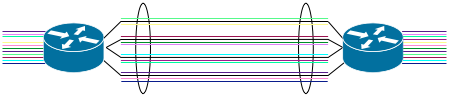
Multiple flows beign distributed across a group of links Traffic is distributed across parallel links via hashing. One or more of the MAC address, IP address, or TCP/UDP port numbers will be hashed to a index and used to select the link. All packets from the same flow will hash to the same value and choose the same link. Given a large number of flows, the distribution tends to be pretty good.

One high bandwidth flow skewing the distributionThe distribution doesn't react to load. If one link becomes overloaded, the load isn't redistributed to even it out. It can't be: the switch isn't keeping track of the flows it has seen and which link they should go to, it just hashes each packet as it arrives. The presence of a few very high bandwidth flows causes the load to become unbalanced.

35 Megabits per second is only a fraction of the capacity of an individual link, but that one flow is by no means the only traffic on the net. Once delivered, the tweets have to be acted upon in some fashion and that results in additional traffic on the network. It would be easy to end up with a number of flows at 35 Mbps each.


IRQs One high bandwidth flow skewing the distribution of IRQs to CPUs

Networks have increased aggregate capacity via parallel links. Servers have increased aggregate capacity via parallel CPUs, and the same issue of keeping packets in order arises. Server NICs distribute the IRQ load across CPUs by hashing, and the same reordering issue arises. A single flow has to go to a single CPU, creating a hotspot in the interrupt handling. The software can immediately hand off processing to other CPUs, but it will be a bottleneck.


Peak vs Sustained

Right now, the unbalanced load should be manageable. The tweetstream is only 35 Mbps, 1/30th the capacity of a network link and 1/10th that of a single CPU core. There is currently some headroom, but there are two trends which will make unbalancing more of a problem in the future:

  1. Tweet volume triples in a year.
  2. 35 Mbps is just an average.

The volume of tweets isn't constant, it suddenly increases in response to events. In March 2011 the record number of tweets per second was 6,939, which works out to 138 Megabits per second. In a year, the peak TPS can be expected to be 416 Mbps. In two years it will be over a Gigabit.

Hardware advances won't keep up with that. At peak times its already causing some heartburn, and it will get a little worse every day. The load needs to be better distributed.

Sunday, May 22, 2011

Tweetbots Need Exercise Too

Tweetbots repeating the same tweet over and overSearch Twitter for the phrase "Right, off to the gym and to listen to the Packetpushers Openflow podcast"

I'll wait.

Note the large number of results, at least as of May 22, 2011. Apparently Twitter is just chock-full of exercise nuts who listen to techie networking content while working out. Yet, its odd that all of them use the exact same phrase. It is also odd that a couple accounts use the same photo.

Of course, its not odd at all: these are all bots. Twitter bots started out very simple, harvesting a random selection of tweets from the stream and using them as their own. They've evolved and become more believable, harvesting tweets of a particular theme. In this case, they selected tweets via exercise-related keywords like "gym" and "workout." That they happened to pick up a highly unusual topic is just dumb luck.

If you examine the tweetstream of any individual bot, its quite believable. They come across as an exercise-obsessed but otherwise normal person. The machine algorithms still fall prey to silly things like a tweet about getting up in the morning followed shortly thereafter by going to bed, but on the whole this crop of bots has advanced considerably since the last time I looked into it. The game is definitely afoot.

One final note: the podcast these bots mention is Packetpushers show 40, and if you are interested in techie networking content it is a good one to listen to. Perhaps you can listen while working out.

Thursday, May 19, 2011

Perspective on a Hot Technology

An observation for those working in a hot technology area.

Hype Cycle leading to acceptance or deadpool

An inflection point is coming. Your actions at the low point influence what happens after.


Tuesday, May 17, 2011

Just Weld It to the Rack

Network equipment chassisThere is a mantra amongst network equipment vendors: never let the customer unscrew the chassis from the rack. Replace every component with upgraded equipment, but never upgrade the chassis itself. Doing so often triggers the customer to send the whole thing out for bid to multiple vendors, and you might not win. Somebody else's chassis might get slotted into the hole you left.

So vendors work very, very hard to keep the old chassis competitive. Line cards and supervisor modules will be updated repeatedly over the lifetime of the system. Though the design of the backplane might also be upgraded in new systems, the new cards have compatible modes of operation for even the oldest deployments.

This has a couple impacts:

  • It favors passive backplanes. Active electronics can't be upgraded, future generations of cards find it a hinderance.
  • It means backplanes are overdesigned, and therefore expensive. Even if you plan to clock traces for 10 Gbps operation, you make the PCB handle 25 or 40 Gbps to support future upgrades. You run as many traces as will fit, even if they won't be used by the first gen cards.

If you ever see a backplane PCB removed from the sheet metal, notice how thick it is. That isn't just for stiffness over the long span of board, backplane PCBs have many signal layers. PCB fabrication gets expensive at 20 layers, but backplanes often have 26 or more. Some of those layers end up using more expensive PCB material, needing better electrical characteristics.

Over the weekend Greg Ferro wrote about a prototype optical backplane from HP on display at Interop, which manages 120 Gbps per optical tap. I think that results in 120 Gbps per slot, though I'm not sure. Optical backplanes have been in development for a long time (consider this announcement from 2005), and even the HP design is 3-5 years away from showing up in a product.

Nonetheless the potential is clear: this is a 10 year backplane. Though the waveguides are plastic not glass, over the short distance of a chassis they should have a vastly larger useable spectrum than copper traces. Subsequent generations of cards can use faster lasers and/or more colors to get the bandwidth they need. Optics (and especially multiple wavelengths) over the backplane adds cost, but the future proofing is worth it.


footnote1: Greg Ferro also hosts the Packet Pushers podcast, which I highly recommend.

footnote2: this blog contains articles on a range of topics. If you want more posts like this, I suggest the Ethernet and Product Development labels.


Wednesday, May 11, 2011

Why Ten Bits is Better Than Eight

Gigabit Ethernet transmits at 1 Gbps, yet if we watch the bits fly by on the wire there are actually 1.25 Gbps. Why is that?

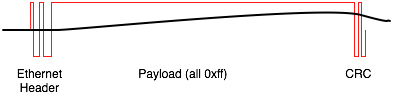
To see why, lets examine a hypothetical Ethernet which does send bits at exactly its link speed. A 0 in the packet is transmitted as a negative voltage on the wire, while a 1 bit is positive. Consider a packet where the payload is all 0xff.

Ethernet transmission

The first problem is that with so many 1 bits, the voltage on the wire is held high for a very long period of time. This results in baseline wander, where the neutral voltage drifts up to find a new stable point.

Neutral voltage creeping up toward the high voltage

Even if we could control baseline wander, we have a more serious problem. There is no clock signal anywhere on the wire. The receiver recovers the clock using a Phase Locked Loop, which means it watches for bit transitions and uses them to infer the clock edges. If there are no transitions, the receive clock will start to drift. The illustration is exaggerated for clarity.

Receive clock getting badly out of sync with transmit

 
Enter 8B10B

Ethernet uses 8B10B encoding to solve these issues. Each byte is expanded into a 10 bit symbol. Only a subset of the 1024 possible symbols are used, those for which:

  1. over time, the number of ones and zeros are equal
  2. there are sufficient bit transitions to keep the PLL locked
Packet after 8b10b encoding expands 25%, but has sufficient bit transitions

Wikipedia has an excellent description of how 8b10b works, in considerable detail.

8b10b is used for Ethernet up to 1 Gbps. For 10 Gigabits, the 25% overhead of 8b10b was too expensive as it would have resulted in a 12.5 GHz clock. At those frequencies an extra gigahertz or two really hurts. Instead 10G Ethernet relies on a 64b66b code, which sounds similar but actually operates using a completely different principle. That will be a topic for another day.

Monday, May 9, 2011

RSS Bucket Dipped Into the Stream

RSS IconYesterday Jesse Stay observed that Twitter and Facebook have both discontinued RSS feeds from various parts of their service. Later that day he commented on the lack of blog reactions. So here you go. Some thoughts, expanded from a comment I left on the original article.

A social service is able to offer a better experience from knowing who their users are and what they are reading. Learning the users interests allows the site to suggest related material, and also target advertising to the specific person. Content publishers in turn can get data about who finds their material interesting, not necessarily identifying the individuals but detailed demographics and related interests.

RSS doesn't fit into that world. The entity fetching the RSS feed is often not associated with an individual user at all, instead being an aggregator or other bit of infrastructure somewhere. Once syndicated via RSS, the originating service loses visibility into who accesses it. The aggregator might report a total number of readers, but not the same rich detail which the service would get natively. Users on RSS are thus far less valuable than users who come to the site, or tools which use the site's (authenticated) APIs. For the originator, tracked activity is much preferred over anonymous content consumption. Paywalls are another symptom of the same underlying phenomena: anonymous content consumption isn't working for the publishers.

Sunday, May 8, 2011

On the Nature of Premium Accounts

Twitter logoFor almost as long as it has existed, people have speculated about premium Twitter accounts as a way to monetize the service. Thus far, no such offering has appeared. Disappointment that premium accounts have never materialized was quite eloquently voiced by Suw Charman-Anderson.

I believe there are two fundamentally different models for premium accounts: either as power users of the free service, or as consumers of the data produced by the free users. Lets consider an example of each.

  • Evernote premium accounts get an enhanced version of the free service. They can upload and index additional file types, and have added features for collaboration.
  • LinkedIn premium accounts access a different type of service. They can examine everyone's connections, not just their own network. It is aimed at recruiters, salespeople, analysts, etc looking for a contact, rather than someone they personally know.

Twitter already offers paid access to its firehose of data, both directly and via gnip. A number of brand tracking, reputation measurement, and sentiment analysis tools use this firehose. Twitter is already well down the path of offering datamining services, but has yet to introduce added features for individual users. Why not? Speculating about some of the premium features which might be offered, and attempting to analyze the impact, is illuminating.

Longer search history: Twitter search goes back only a handful of days. So far as I can tell, it searches the volume of tweets which will fit into RAM across a reasonable number of servers. Searching a much larger volume of tweets would call for a different architecture, possibly involving databases on disk and a vastly larger pool of servers to handle the load.

Might Twitter offer enhanced search as a paid service, stretching back much further in time and additional search operations? That seems likely, but I would point out that even today search is not tied to your account. The search is of the public tweetstream, with no biasing for those you follow. If Twitter offers an enhanced search product it could do so as a datamining feature, not tied to a premium account.

Analytics: How many people clicked on a t.co link? How many people saw a tweet (defined as their client actually fetching it)? These features appear tied to an account and good material for premium features, but consider what people willing to pay for it are really trying to do: measure the effectiveness in spreading an idea, a brand, a celebrity name, etc. Knowing how many people saw their own tweet isn't enough: they need to know about retweets, and even quoted paraphrases of their tweet. Knowing how many times their own t.co link was clicked isn't enough, they want to know how many times any link to their URL was clicked on.

If you're trying to measure effectiveness, analyzing just one account isn't enough. The demand for analytics is primarily a datamining feature.

Group Messaging: Would twitter offer a service which allowed premium accounts to send group DMs? Meaning, send a message which can be seen by multiple participants but not be publicly searchable. Presumably this would be tied in with Twitter lists. The existence of Beluga, GroupMe, Kik, etc implies there is a demand for such a service not filled by existing tools like email.

In terms of Twitter's business, the downside of a group messaging facility is that it reduces the value of the datamining service. If taking a conversation off the record is simple, people will use it. Influencers with many contacts are perhaps even more likely to use it, and that is data which Twitter wants to be part of the zeitgeist firehose they offer.

Other features: People ask for the ability to retrieve more than the most recent 3200 of their own tweets, for higher hourly rate limits, etc. It would be quite possible to offer premium accounts with substantially higher limits. Yet consider the reaction once such accounts are available: these are features which the free accounts have, but which are artificially limited. Lifting the limit doesn't feel like a premium feature, it feels like extortion. Lifting limits isn't a good basis for a premium account, you need a strong core feature set.


A Conclusion

Offering both premium features for individual accounts and datamining services over the tweetstream is difficult, as the two are often in conflict. Individual users want to maximize their own effectiveness and, quite frankly, reserve the benefits of their use of the service to themselves by restricting access to their tweets. Removing data from the public stream reduces the value of the firehose. I suspect this is the reason Twitter has not offered such accounts, as datamining the firehose is held to be more valuable. Offering premium accounts would inevitably bring pressure to offer the features which damage the value of the firehose.

Thursday, May 5, 2011

Intel 22nm and Mobile Computing

Yesterday Intel announced details of their 22nm silicon process. There were a number of fascinating details on how the transistors are made, but one graph from the presentation presages what will happen in the mobile market over the next several years.

current versus voltage

As the voltage goes to zero, the consumed current goes to zero. It sounds obvious, but really isn't. Even when nominally "off," transistors have always leaked current into the substrate. As silicon features have gotten smaller the power they consume while active has declined rapidly, but the leakage current less rapidly.

Other graphs in the presentation show a tradeoff between operating voltage and leakage current, which means power consumed while active versus power consumed at all times. Intel's production chips will likely tolerate a little leakage to get lower voltage, but still very low.

In 32nm silicon processes leakage current may already be the primary factor in power consumption. It is difficult to estimate how serious the effect is, but this article from March 2008 shows leakage current as relatively insignificant in 180 nm silicon but growing to nearly 40% of total power consumption in a 50 nm process. We're at 32nm now.

Except Intel just changed the game.

ARM has several advantages in the mobile space. Their products are available from many manufacturers and their support in software toolchains is nearly universal, but their biggest advantage has been low power consumption compared to x86 or other architectures. ARM did a great job designing chips which are very sparing of the power they consume while operating.

Except Intel just changed the game.

Intel now has a silicon process with radically lower leakage current. x86 consumes more power while actively operating, but leakage current is more significant. ARM's competitive advantage has shrunk substantially. Expect to see a lot more x86 CPUs in mobile devices, starting in late 2011.

Wednesday, April 27, 2011

Discrimination on the Basis of Bytes

There is no length field in the Ethernet header (*). The MAC infers how long the frame is by noticing when the carrier goes away, and relies on the CRC to catch truncated or overlength frames. After removing the Ethernet header and CRC, what is left is payload. (*) It isn't quite that simple, as the optional LLC header adds a length field. As is customary when talking about Ethernet, I'll ignore the existence of LLC.

Ethernet packet with source address, destination address, ethertype, payload, and CRC
Protocol:Whatever. When I send N bytes, the other station will receive N bytes. Thats all I care about.
Ethernet:Not quite. The sending device will add padding to 64 bytes.
Protocol:Whatever. The receiver removes the padding, right?
Ethernet:No.
Protocol:&%#@*!

The minimum Ethernet frame size has been a source of confusion for decades. From protocol implementors miffed at getting garbage after their data to driver writers who forget to zero out the padding and end up leaking kernel data onto the wire, its been a hoot. So why have a minimum size?


Wayback Machine to 1976 Ethernet network with 5 segments, 4 repeaters, and a bunch of hosts

Ethernet was designed for half duplex operation. If two stations check for a carrier at the same time they might both start transmitting, resulting in a collision. Reliably detecting collisions is important: though Ethernet has never guaranteed delivery, collisions are so common that relying on protocols to retransmit would have resulted in a miserable network.

In the IEEE standard 10 Megabit Ethernet allows up to 5 segments separated by 4 repeaters between any two stations.

  • The minimum frame size is 512 bits.
  • A segment of 10BASE-5 can be 500 meters long, where the speed of light is 0.77c. A signal takes 2.17 microseconds to propagate 500m, which is 22 bit-times.
  • It takes some time for bits to propagate through a repeater. I have no confirmed numbers, but an estimate to synchronize between clock domains plus a little buffering to avoid underruns is 24 bit-times.
  • 5 segments x 22 bit times + 4 repeaters x 24 bit times = 206 bit-times.

Station A can start transmitting and its bits almost make it before B checks the carrier and begins transmitting. We need to allow for two crossings of the network, or 412 bit times. Adding some margin for safety and rounding up to the next power of 2 gives us the 512 bit minimum frame size.

So thats how we ended up with 64 byte minimum packets, by defining requirements for distance and working out propagation delays, right? ... Well, no.


The Plot Thins

Ethernet products were available prior to IEEE standardization. As originally specified it allowed for two repeaters and a maximum of three segments between any two hosts, yet still had a minimum frame size of 64 bytes. It could have gotten by with less.

As with so many things in technology, I believe the 64 byte size was chosen mainly for expediency. They knew they needed to listen for collisions, and made some calculations on propagation delay. The earliest Ethernet equipment was constructed out of discrete SSI parts and memories, and I suspect 64 bytes of buffer was available. So there we are.

IEEE defined the repeater limits to match the pre-existing minimum frame size, not the other way round.


Consequences

Though padding sounds wasteful of bandwidth, in practice it doesn't matter. A truism in networking is that most packets are small, but most data is carried in the large packets. Real networks are not made up of minimum sized frames at the link rate, but that is how they are tested. Read any review and you'll find the packet forwarding rate, measured using test equipment sending 64 byte frames at wire speed.

Switch fabric designers are grateful for the minimum frame size: it puts a cap on packets per second. Without the 64 byte minimum, the forwarding logic would have to design for 3x as many packets per second. Real networks don't operate that way, but if you can't handle it your gear gets tossed out of the lab. Really, it would be nice if the minimum frame were even a bit bigger.

Wednesday, April 20, 2011

A Tale of Two MACs

If you've looked at the spec sheets for 10 Gig server NICs, you may have noticed something interesting: the feature set supported when operating at 10 Gig is often not the same as the feature set for 10/100/1000 Mbps. Usually, the 10G features are a subset of the lower speed options.

Modern NIC designs essentially always contain a CPU helping out with datapath operation, and sometimes this feature disparity is due to an inability to keep up with processing at the higher link rate. However, that isn't the entire story.


The Care and Feeding of Half Duplex

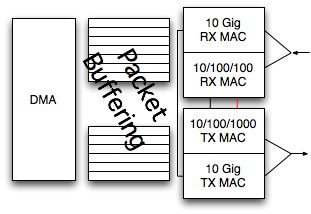
Lets discuss what goes in to an Ethernet NIC. The block diagram shown here isn't comprehensive, its intended to highlight only those aspects to be discussed further. We start with a DMA engine, plus buffering for sent and received packets. The MAC design is typically split into TX and RX modules for chip layout reasons. Control signals run between RX and TX to support flow control, where a received pause frame will make the transmitter cease sending packets. As Ethernet pause is frame by frame, the timing for this control signal is fairly relaxed. NIC ASICs also generally integrate the PHY to reduce cost, but 10G copper PHYs are new enough that this is not yet always done.

Ethernet NIC showing MAC, packet buffering, and DMA

You'll note that the TX and RX MACs are further subdivided, with a red line running from the middle of RX to the middle of TX. This is used for half duplex operation. While transmitting half duplex, the MAC compares what it sees on the wire to what it is transmitting. When the received bits don't match the sent, it means another station is transmitting at the same time and they have collided. Both MACs cease transmitting and back off.

Further, there are two switches in the middle of the red line. While the station is transmitting with the received signal fed to the TX MAC, it is important that the RX MAC not process the data. It isn't a packet: the rx counters should not be incremented and the payload should not be handed to the software as a received frame. The RX MAC is disconnected until the transmission finishes, then resumes listening for packets.

Support for the Gigabit half duplex comes with additional complexity. For reasons which would take too long to describe here, half duplex at gigabit speed requires the MAC to implement frame bursting. The MAC transmits multiple frames without dropping the carrier, to ensure that collisions can be detected. Though this isn't terribly difficult, it is yet another bit of complexity which has to be tolerated to support a feature which hardly anyone actually uses.


A Tale of Two MACs

Half duplex was the only option for Ethernet networks until just sightly before 100 Mbps Ethernet debuted. For the most part the transition to switched networks running full duplex happened during the 100 Mbps era. By the time Gigabit Ethernet debuted, full duplex operation was the norm with half duplex used by an ever diminishing sliver of the market. Though Gigabit Ethernet defines a half duplex mode, it is rarely used and a number of early gigabit products didn't work properly in half duplex mode.

Ethernet NIC showing two MACs, one for 10G and one for 10/100/100010 Gig Ethernet does not have a half duplex mode. It always operates full duplex.

It is difficult to implement a MAC hardware design which handles the full range of link speeds from 10 Mbps all the way up to 10 Gbps, three orders of magnitude faster. Add in a requirement to run a time-critical signal all the way across the chip and between TX/RX clock domains, plus gigabit frame bursting, and it becomes even harder.

Therefore some hardware designs punt, and include what are recognizably two MACs. One is used for 10/100/1000 operation, supports half duplex operation, and is most likely derived from an existing design from older products. The 10G MAC is new, only supports full duplex, and has wider datapaths needed for higher speed operation. It only supports features useful for server deployments, because at this point 10G is too expensive for desktop or other uses. The chip chooses between the two MACs based on the link speed, the result of autonegotiation or explicit configuration.

The feature set is different for 10G operation because internally it really is different. Nonetheless, it operates as just one interface. The two MACs might be visible to the driver software, but not above that. To the rest of the software stack, its just one NIC.

Monday, April 18, 2011

Early Market Development

Baby Caterpillar toy with bird logo that looks like Twitter

Twitter client developers have come up with some awfully creative niches to target.


Wednesday, April 13, 2011

Don Knuth Q&A

Don Knuth visited Google in March. He had no prepared notes, instead answering a series of questions from the audience. The video of the talk posted to YouTube the next day.

My favorite answer was about digital typography, despite being personally unable to distinguish much beyond monospace and proportional fonts. I think the answer is very revealing of character.

Q:You are famously known for your interest in (and contributions to) digital typography. Over 30 years after the release of TeX, what are your thoughts on the current state of typography as it exists on the web and other digital media?
A:I’m upbeat about [it]. I got a Nexus S and it has beautiful fonts on it. I love the typography that I’m seeing. I think that people are starting to understand fonts. I’m famously bad at predicting. The fact that I can’t predict how hard something is is the only reason I started working on typography in the first place, and Art of Computer Programming and a bunch of other stuff, but I did predict that font designers would become heroes, and that turned out to be fairly close to the mark.

Monday, April 11, 2011

IPv6 Addresses for Fun and Profit

The IPv6 address is 128 bits, divided into a 64 bit network portion and a 64 bit host portion. The network portion is so large that organizations are generally issued a block of 256 or more, in order to let each geographic site have a unique prefix. Therefore the admins get to control the lower 8 or more bits of the address advertised to the world via DNS... and many people are using tired old deca:fbad and c0ed:babe addresses. This is our chance! Its a brave new world, with huge swaths of IP address space available, and we should make the most of it.

Presented here for your edification and bemusement are suggested choices for the lower bits of IPv6 network addresses.

a110:c8edI allocated an address, just for you.
defa:cedI hate my web designer.
bad:fac:adeOur CSS needs work.
bad:deedThank you for visiting my site. Really.
be:fa11As in "what has befallen yon dead server?"
abba:ca:dabaOur network is powered by pure magic.
d00:beeNetwork debugging probably qualifies as "medicinal purposes."
b0:cce:ba11You know, I only discovered Bocce Ball in my 30s.
5ca1:ab1eIgnore what you see elsewhere, the secret to scalability is in using clever IP addresses.
ca:b0byummy
fa1:afe1even more yummy!
b1ab:bedWe might need to tighten up our HTML a bit.
bab:b1eWe might need to recompress our images a bit.
ba:b00My sweet baboo!
10ad:edI bet it has an itchy trigger finger, too.
ba:11adThe entire site is set in iambic pentameter.
a:100fMy site doesn't like me.
acc0:1adeNetwork admins rarely, if ever, hear praise of their work.
aff:ab1eAn address for a social networking site if ever I heard one.
ba:ff1eDon't blame me for the contents of this site. The web team reports to a whole different department from the network admins.
ba1:b0aIts the Eye of the Tiger, baby!
ed1:f1ceLook upon my network, ye Mighty, and despair.
5caf:f01dThis load balancing tier was intended to be temporary. That was four years ago. Such is the way of things.

Finally, here are some 16 bit numbers which are more interesting than "dead," "f00d" and "beef"

cacaA statement about the website quality, I suppose.
deafThis is a transmit-only network.
ba1dIf tires can go bald, why not networks?
a1faI couldn't find a reasonable approximation of beta.
f01dOrigami networking!
fa11If a site falls in the forest, does it make a sound?
c01dNetworking is a dish best served cold.
ab1eOr ! 0xab1e, as the case may be.
b0deBeware the Ides of March.
cedeI give up, I'm done.

This post was inspired by several tweets by Dan Morrill. BTW, this post is 100% recycled content.

Friday, April 1, 2011

New blogger.com Distribution Option

Yesterday Blogger announced Dynamic Views, with several snappy new layout options. However a new option of far more import to Blogger users was rolled out silently, with no announcement and no fanfare. A new publication option, feeding into a network with global reach and massive installed base, is now available.

Blogger UUCP publish help pages

I'm planning to syndicate to alt.google.blogger.codingrelic. I've also reserved alt.google.blogger.codingrelic.die.die.die, so don't even think about it.